Winds, days and a long year
The windiest world, at the dim end of the sunlight.
NASA Science gives winds of more than 1,200 miles per hour. The fact sheet lists 0–580 metres per second. A year is 60,189.018 days, or about 165 Earth years. All of those official wordings stay in the same room.
Far from the Sun, and still the windiest place in the neighbourhood.
A desk of official clocks and official winds
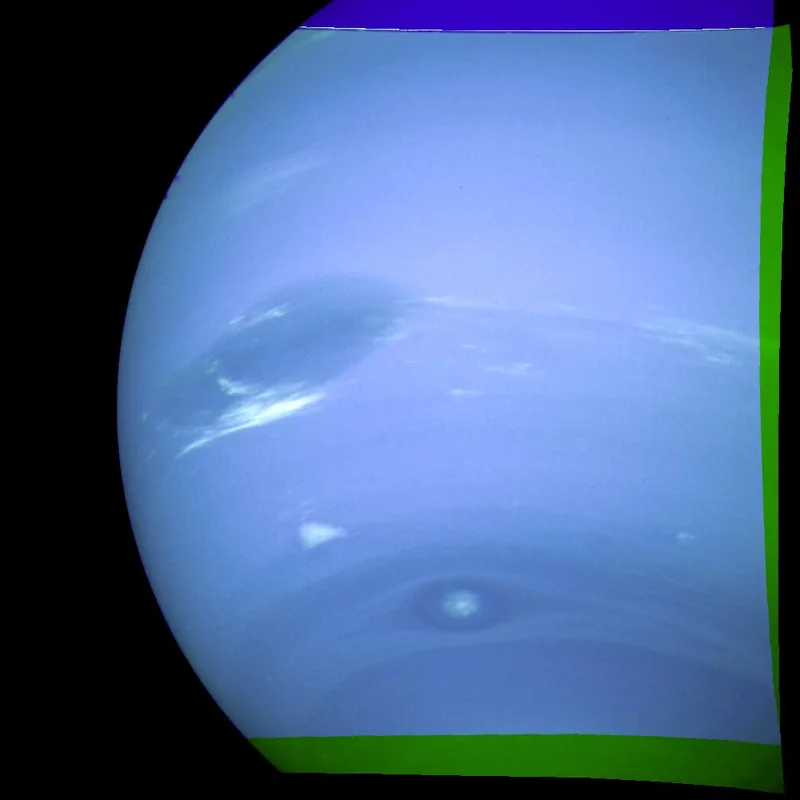
NASA Science says that despite Neptune’s great distance and low energy input from the Sun, its winds can be three times stronger than Jupiter’s and nine times stronger than Earth’s, whipping clouds of frozen methane at more than 1,200 miles per hour (2,000 kilometres per hour). Even Earth’s most powerful winds, the same page says, hit only about 250 miles per hour (400 kilometres per hour). [source] The official fact sheet lists wind speeds as 0–580 m/s. [source] Those two official wordings are not averaged here.
A day, on the fact sheet, is 16.11 hours, with an asterisk: the rotation is given in magnetic coordinates, as determined by the Voyager 2 Radio Science experiment. [source] NASA Science says one day takes about 16 hours. [source] A year is longer than a human career. The fact sheet’s sidereal orbit is 60,189.018 days, a ratio of 164.79 against Earth’s year. [source] NASA Science says Neptune makes a complete orbit in about 165 Earth years (60,190 Earth days), and that in 2011 it completed its first 165-year orbit since its discovery in 1846. [source]
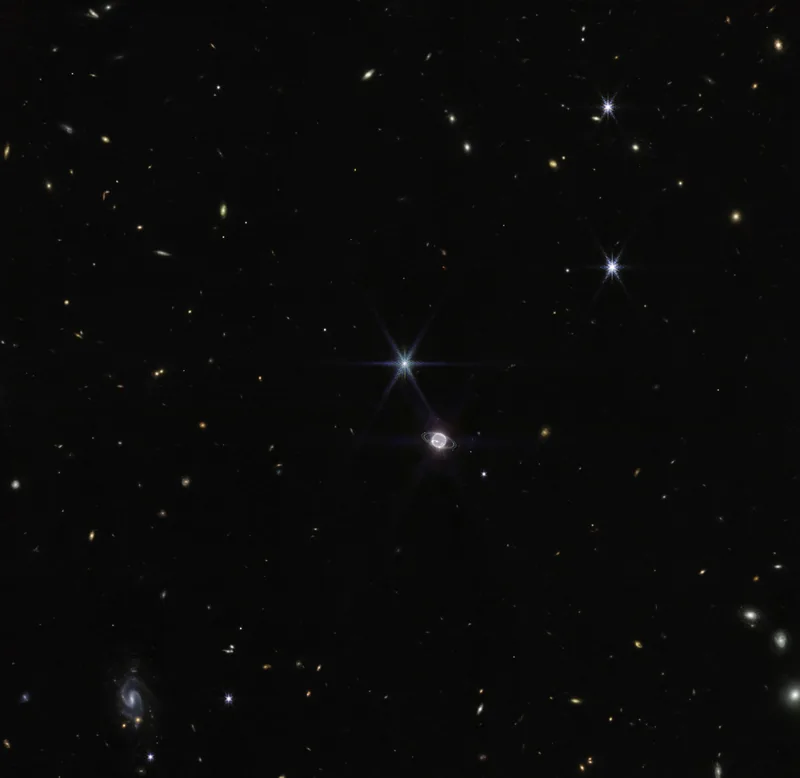
The light is thin when it arrives. NASA Science says high noon on Neptune would seem like dim twilight to us, and that the warm light we see on Earth is roughly 900 times as bright as sunlight on Neptune. [source] The fact sheet’s solar irradiance is 1.508 W/m2 against Earth’s 1,361.0, a ratio of 0.0011. [source] Sunlight takes four hours to travel from the Sun to Neptune, on NASA Science’s wording, from an average distance of 2.8 billion miles (4.5 billion kilometres), or 30 astronomical units. [source] The fact sheet’s semimajor axis is 4,514.953 × 106 km, or 30.06896348 AU in the mean orbital elements. [source]
The axis is tilted 28.32 degrees on the fact sheet. [source] NASA Science says 28 degrees, similar to Mars and Earth, so Neptune has seasons — but because the year is so long, each of the four seasons lasts for over 40 years. [source]
Enjoyed a planet found with a pencil, and the solar system’s windiest world?
No pop-ups. No intrusive advertising. Just interesting stuff. A little support helps the next planets.im site get built.