Official figures
A fact sheet, and a facts page, side by side.
Tabulated numbers and public wording are both official. This page does not average them.
Tabulated figures are from the NASA / NSSDCA Neptune Fact Sheet. [source] Public wording is from NASA Science’s Neptune facts page. [source] Where they differ, both are kept.
- Discovery
- Fact sheet: Johann Gottfried Galle, based on predictions by John Couch Adams and Urbain Leverrier, 23 September 1846. NASA Science: Le Verrier sent predictions to Galle, who found the planet on his first night of searching in 1846; Galileo had recorded it as a fixed star in 1612 and 1613.
- Mass, volume, radius
- Fact sheet: mass 102.409 × 1024 kg, ratio 17.15; volume ratio 57.74; equatorial radius (1 bar) 24,764 km, ratio 3.883; polar radius 24,341 km; volumetric mean radius 24,622 km. NASA Science: equatorial diameter 30,775 miles (49,528 kilometres), about four times wider than Earth; if Earth were the size of a nickel, Neptune would be about as big as a baseball. A Webb file caption on this site uses a basketball for the same nickel comparison; that caption is not merged with Science’s baseball.
- Density and gravity
- Fact sheet: mean density 1,638 kg/m3, ratio 0.297; gravity (mean, 1 bar) 11.27 m/s2, ratio 1.15; escape velocity 23.5 km/s. NASA Science: of the giant planets, Neptune is the densest; most (80% or more) of its mass is a hot dense fluid of “icy” materials — water, methane, and ammonia — above a small, rocky core.
- Distance and light time
- Fact sheet: semimajor axis 4,514.953 × 106 km; mean orbital elements 30.06896348 AU; perihelion 4,471.050 × 106 km; aphelion 4,558.857 × 106 km. NASA Science: average distance 2.8 billion miles (4.5 billion kilometres), 30 astronomical units; sunlight takes 4 hours to travel from the Sun to Neptune.
- Year
- Fact sheet: sidereal orbit 60,189.018 days, ratio 164.79; tropical orbit 59,799.900 days. NASA Science: about 165 Earth years (60,190 Earth days). In 2011 it completed its first such orbit since 1846.
- Day and tilt
- Fact sheet: sidereal rotation 16.11 hours (asterisk: magnetic coordinates, Voyager 2 Radio Science); length of day 16.11 hours; obliquity 28.32°. NASA Science: about 16 hours; axis tilted 28 degrees, so seasons last over 40 years each.
- Sunlight
- Fact sheet: solar irradiance 1.508 W/m2, ratio 0.0011 against Earth’s 1,361.0. NASA Science: high noon would seem like dim twilight; Earth’s sunlight is roughly 900 times as bright.
- Atmosphere and winds
- Fact sheet, by volume: molecular hydrogen 80.0% (3.2%); helium 19.0% (3.2%); methane 1.5% (0.5%); temperature 72 K (−201°C) at 1 bar and 55 K (−218°C) at 0.1 bar; wind speeds 0–580 m/s. NASA Science: mostly hydrogen and helium with a little methane, which reflects blue; winds more than 1,200 miles per hour (2,000 kilometres per hour).
- Moons and rings
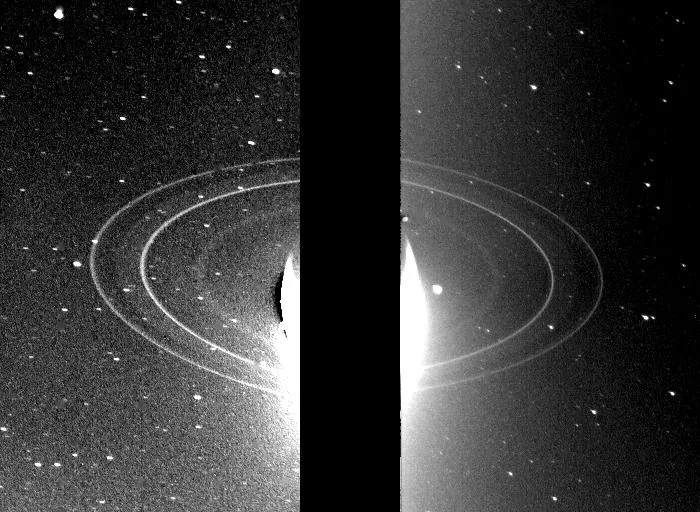
- Both official pages: 16 known moons. NASA Science: at least five main rings (Galle, Leverrier, Lassell, Arago, Adams) and four prominent arcs (Liberté, Egalité, Fraternité, Courage) in the Adams ring.
- Magnetosphere
- Fact sheet: dipole tilt 46.9 degrees; dipole offset 0.485 Rn; surface field ~0.1–0.9 Gauss. NASA Science: main axis tipped about 47 degrees; the field is about 27 times more powerful than Earth’s.
Enjoyed a planet found with a pencil, and the solar system’s windiest world?
No pop-ups. No intrusive advertising. Just interesting stuff. A little support helps the next planets.im site get built.