Discovery
The first planet found with a pencil — and a previous cameo as a star.
Galle found it on his first night of searching, from a predicted position. The official fact sheet also names John Couch Adams beside Urbain Leverrier. Galileo had already written it down, as a fixed star, in 1612 and 1613.
Because Uranus didn’t travel exactly as astronomers expected, NASA Science says, the French mathematician Urbain Joseph Le Verrier proposed the position and mass of a then-unknown planet that could cause the changes. He sent his predictions to Johann Gottfried Galle at the Berlin Observatory, who found Neptune on his first night of searching in 1846. [source] The fact sheet names Galle as discoverer, based on predictions by John Couch Adams and Urbain Leverrier, and gives the date as 23 September 1846. [source] Adams is on the fact sheet; Science’s narrative on this page leads with Le Verrier’s letter. Both official accounts are kept.
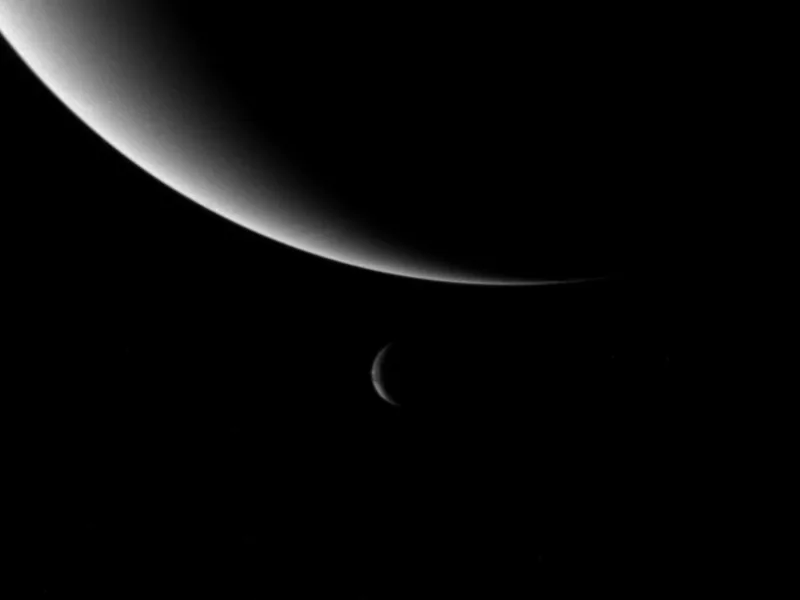
Seventeen days later, NASA Science says, William Lassell discovered Triton, on 10 October 1846. [source] The ice giant had already, without anyone knowing, left a trace in an older notebook. Galileo recorded Neptune as a fixed star during observations with his small telescope in 1612 and 1613. [source]
The planet is named for the Roman god of the sea; its moons, NASA Science says, are named for various lesser sea gods and nymphs in Greek mythology. [source] In 2011, more than a century and a half after Galle’s night at the telescope, Neptune completed its first 165-year orbit since that discovery. [source]
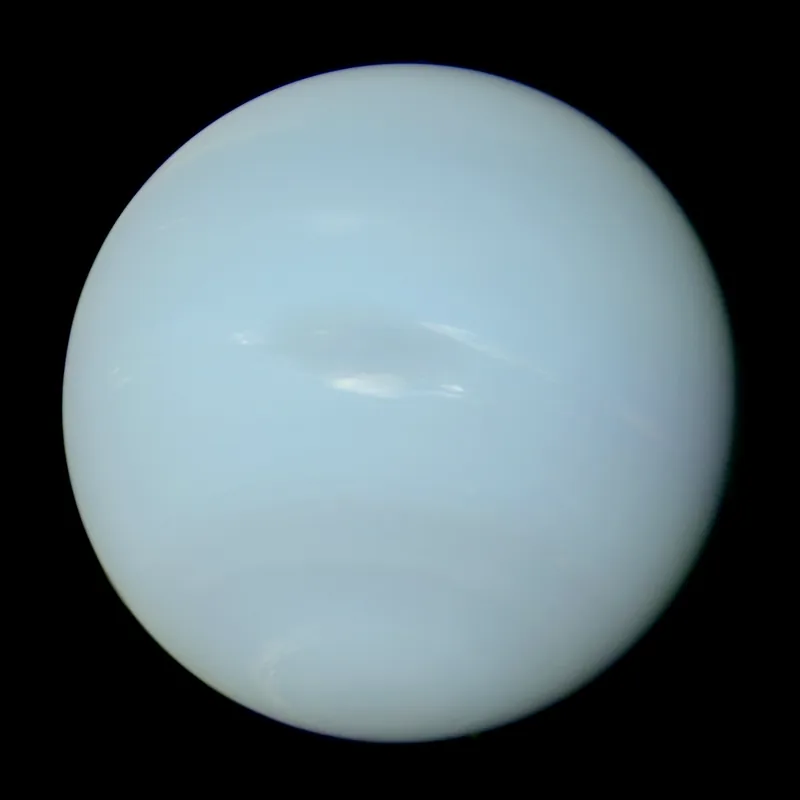
Voyager 2 is still the only spacecraft to have visited. NASA Science describes the familiar 1989 portraits, and then the later reprocessing. [source] The still above is a colour-calibrated composite of Voyager frames from 17 August 1989, published as CC0 and based on Irwin et al. (23 December 2023). It is here because the colour story is part of the planet’s modern history, and it is labelled as a reprocess.
Sometimes, NASA Science adds, Neptune is even farther from the Sun than dwarf planet Pluto. Pluto’s highly eccentric orbit brings it inside Neptune’s orbit for a 20-year period every 248 Earth years, most recently from 1979 to 1999. They cannot crash: for every three laps Neptune takes around the Sun, Pluto makes two. [source]
Enjoyed a planet found with a pencil, and the solar system’s windiest world?
No pop-ups. No intrusive advertising. Just interesting stuff. A little support helps the next planets.im site get built.