Myths versus facts
A few things Neptune is not.
The enhanced-colour portraits, the vanished storm, and the dwarf planet that sometimes comes closer all have official wording. This page keeps it.
Myth: you can see Neptune with the naked eye
NASA Science says Neptune is the only planet in our solar system not visible to the naked eye. Uranus is just barely visible for those with excellent eyesight under dark-sky conditions, provided you know where to look. [source]
Myth: the famous deep-blue Voyager portrait is simply “how it looks”
The file for that portrait calls it enhanced-color. NASA Science says the Voyager team tweaked many images toward a deeper blue to reveal clouds, and that a 2024 reprocess shows the ice giants looking more alike than many thought. [source] A 1989 catalog frame on this site is separately captioned as processed “to obtain true color balance.” Labels first, arguments later.
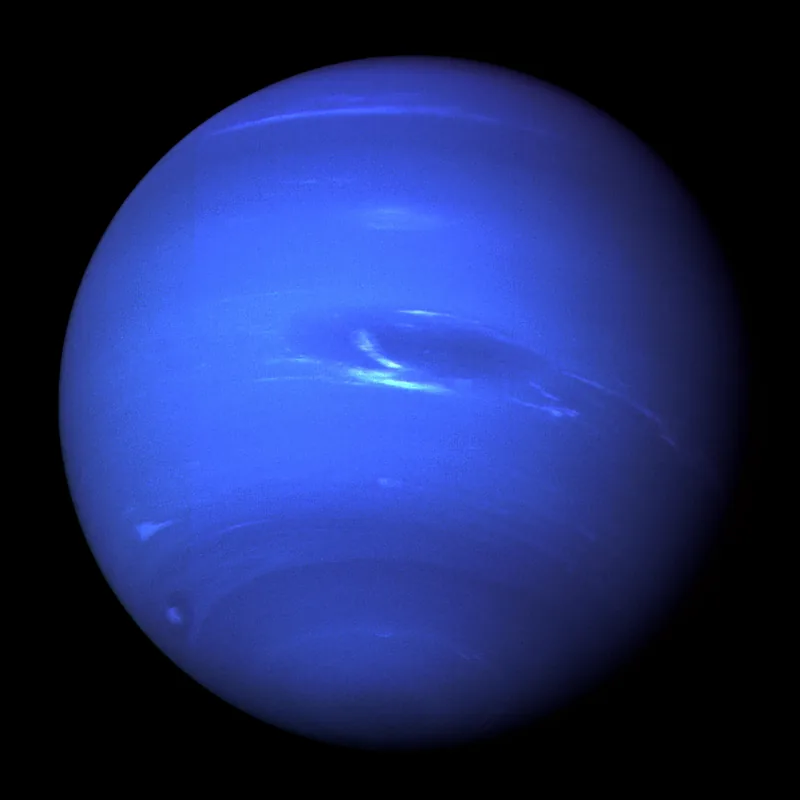
Myth: the Great Dark Spot is still there, like Jupiter’s Great Red Spot
NASA Science says the 1989 storm was large enough to contain the entire Earth, and that it has since disappeared, though new dark spots have appeared on different parts of the planet. [source]
Myth: so far from the Sun, the winds must be weak
NASA Science calls Neptune our solar system’s windiest world, with winds that can be three times stronger than Jupiter’s and nine times stronger than Earth’s. [source] The fact sheet’s range is 0–580 m/s. [source]
Myth: Neptune is always farther from the Sun than Pluto
NASA Science says sometimes Neptune is even farther from the Sun than dwarf planet Pluto. Pluto’s oval orbit brought it inside Neptune’s path for twenty years every 248 Earth years, most recently from 1979 to 1999. A 3:2 repeating pattern, the same page says, prevents close approaches. [source] Pluto is a dwarf planet on that official wording, and on this site.
Myth: a captured caption is as good as a fact sheet
A 2022 Webb file on this site says Neptune has 14 known satellites. The fact sheet and NASA Science, checked on 18 November 2026, both say 16. The caption is quoted, dated, and left uncorrected. That is the point of checking.
Enjoyed a planet found with a pencil, and the solar system’s windiest world?
No pop-ups. No intrusive advertising. Just interesting stuff. A little support helps the next planets.im site get built.