Moons and rings
A moon that orbits backward, and ring arcs that refuse to spread out.
Both official pages give Neptune 16 known moons. Triton, found 17 days after the planet, is retrograde, geyser-bearing, and extremely cold. The Adams ring keeps four named arcs, against what the laws of motion would first suggest.
Neptune has 16 known moons on both the official facts page and the official fact sheet. [source] [source] Triton is the largest. NASA Science says it is the only large moon in the solar system that circles its planet in a direction opposite to the planet’s rotation — a retrograde orbit — which suggests it may once have been an independent object that Neptune captured. [source]
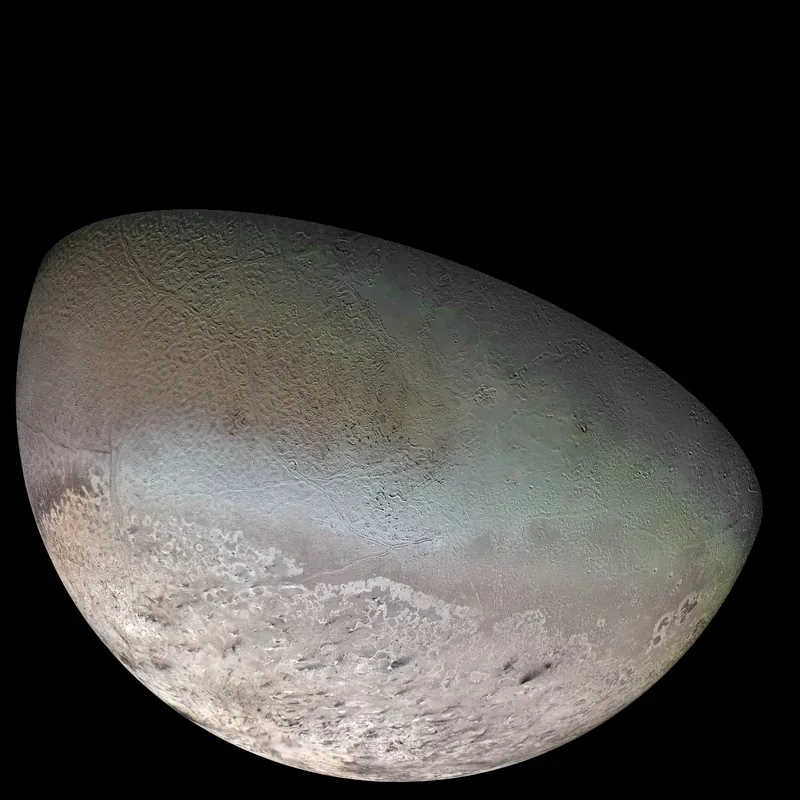
It is extremely cold, NASA Science says, with surface temperatures around minus 391 degrees Fahrenheit (minus 235 degrees Celsius). And yet Voyager 2 discovered geysers spewing icy material upward more than 5 miles (8 kilometres). Triton’s thin atmosphere, also discovered by Voyager, has been detected from Earth several times since, and is growing warmer; scientists do not yet know why. [source]
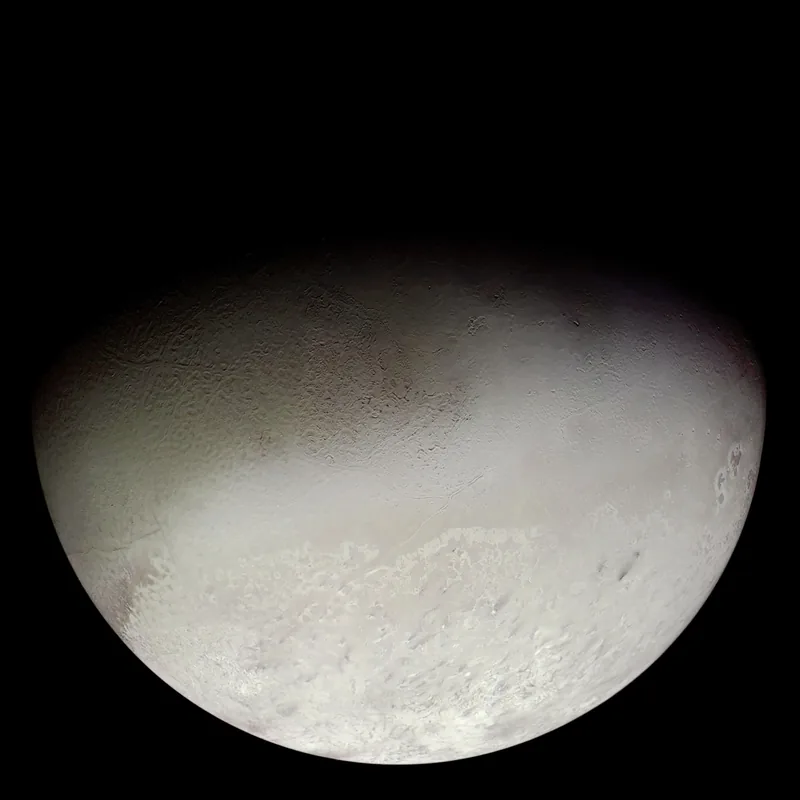
The processed mosaic above, credited to NASA / Ted Stryk, places the south pole at the left and notes that several of Triton’s famous south polar geysers are visible, with “cantaloupe terrain” toward the equator. A processed mosaic, as labelled.
Rings, and four arcs that should not stay put
NASA Science says Neptune has at least five main rings and four prominent ring arcs known so far. Starting near the planet and moving outward, the main rings are named Galle, Leverrier, Lassell, Arago, and Adams. The rings are thought to be relatively young and short-lived. [source]
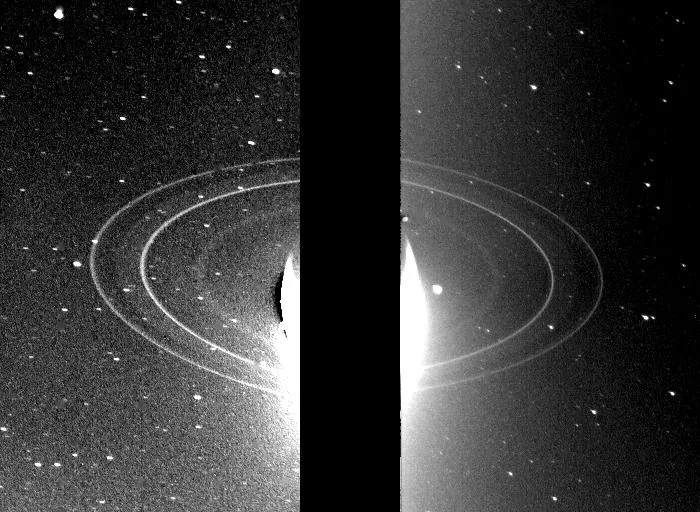
In the outermost ring, Adams, material mysteriously clumps into arcs named Liberté, Egalité, Fraternité, and Courage. The arcs are strange, NASA Science says, because the laws of motion would predict that they would spread out evenly rather than stay clumped together. Scientists now think the gravitational effects of Galatea, a moon just inward from the ring, stabilises these arcs. Distances in the official table come from the U.S. Geological Survey Gazetteer of Planetary Nomenclature, cited on the same NASA Science page. [source]
One careful caption note: a 2022 Webb file on this site labels seven visible moons and says “Neptune has 14 known satellites.” That was the file’s wording at the time. The official fact sheet and NASA Science facts page, checked on 18 November 2026, both say 16. [source] [source] The caption is not silently corrected.
Enjoyed a planet found with a pencil, and the solar system’s windiest world?
No pop-ups. No intrusive advertising. Just interesting stuff. A little support helps the next planets.im site get built.