Discoveries
Unusual things official pages say about Neptune.
A world written down as a star, found with mathematics, visited once, and still able to surprise a colour calibration two generations later.
A planet written down before it was found
Galileo recorded Neptune as a fixed star in 1612 and 1613. More than two centuries later it became the first planet located through mathematical predictions. [source] Galle’s first night of searching, 23 September 1846, still has the fact sheet’s date. [source]
A year that took until 2011 to happen once
NASA Science says that in 2011 Neptune completed its first 165-year orbit since its discovery in 1846. [source] The fact sheet’s precise sidereal orbit is 60,189.018 days, or 164.79 Earth years. [source]
The only flyby, and a storm that vanished
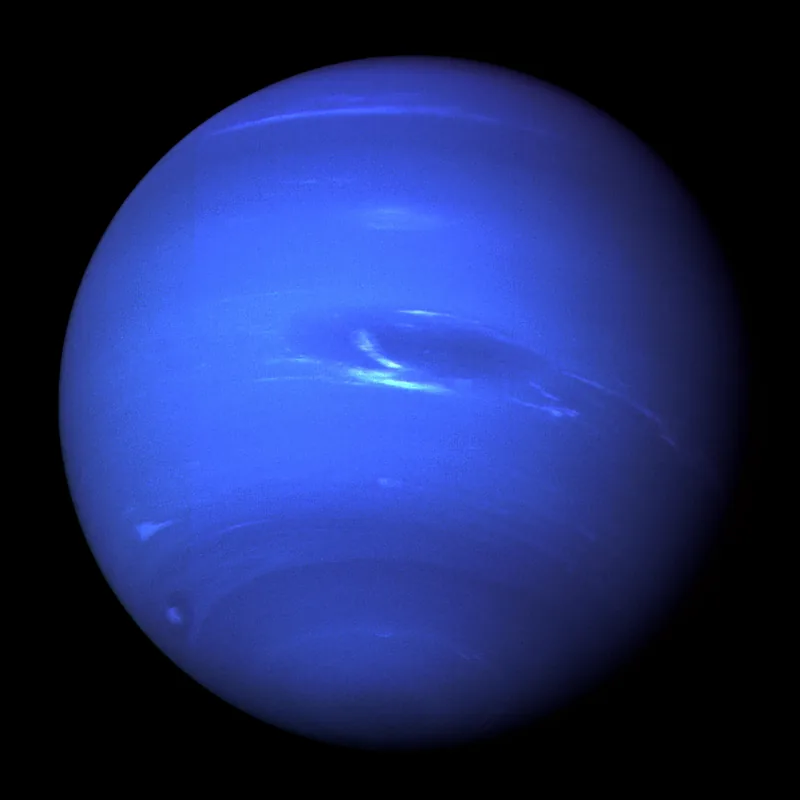
Voyager 2, in the summer of 1989, became the first spacecraft to fly by the planet — and remains the only one, on the official telling of that encounter. [source] It found the Great Dark Spot, large enough to contain the Earth, which has since disappeared, and a moon with geysers more than five miles high. [source]
A deeper blue that was tweaked, then revisited
NASA Science says the Voyager team tweaked many images toward a deeper blue to reveal clouds, and that researchers in 2024 re-processed them, showing Uranus and Neptune look much more alike than many thought. [source] The colour-calibrated composite on the weather page is a later reprocess based on Irwin et al. (23 December 2023), labelled as such.
Rings seen again, in infrared
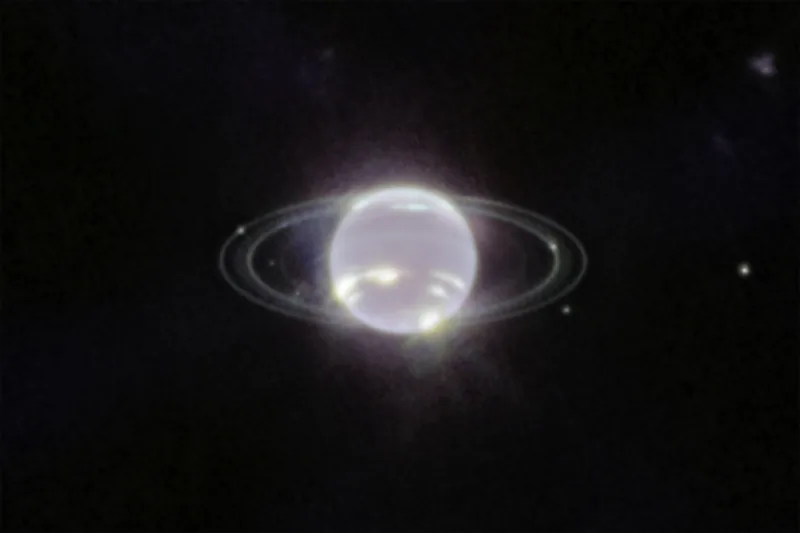
Webb’s 12 July 2022 NIRCam portrait, the official caption says, brought Neptune’s rings into full focus for the first time in more than three decades, including — in the wider official comments on the same observation — rings not detected since Voyager 2.
A 3:2 dance with a dwarf planet
Pluto’s oval orbit brought it inside Neptune’s path from 1979 to 1999. NASA Science is clear that they cannot crash: for every three laps Neptune takes, Pluto makes two. [source] Pluto is labelled a dwarf planet on that official page, and on this site.
Enjoyed a planet found with a pencil, and the solar system’s windiest world?
No pop-ups. No intrusive advertising. Just interesting stuff. A little support helps the next planets.im site get built.