A storm large enough to hold the Earth — and a blue that was, in part, a choice.
NASA Science says the Great Dark Spot of 1989 has since disappeared, and that many famous Voyager portraits were tweaked toward a deeper blue. A later official facts page, and a later colour-calibrated composite, sit beside that wording.
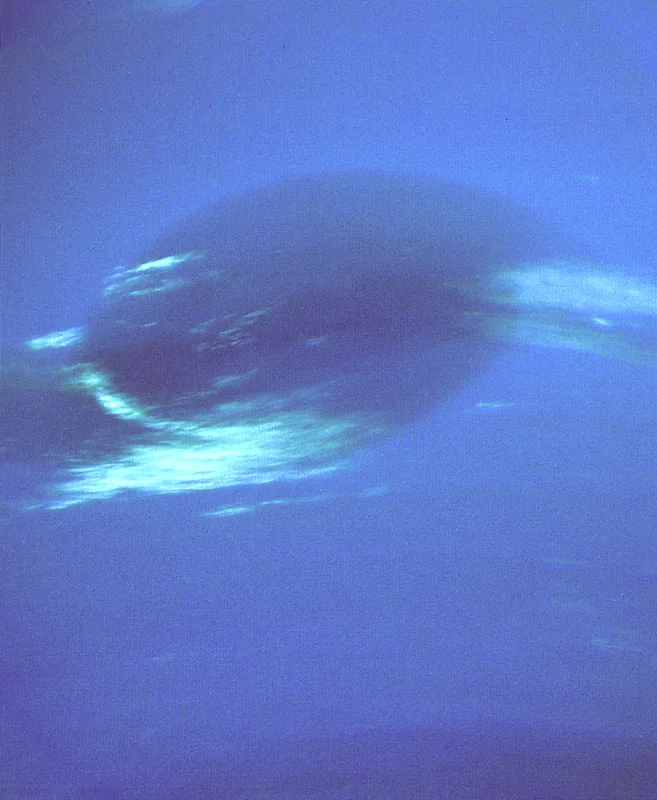
In 1989, NASA Science says, a large, oval-shaped storm in Neptune’s southern hemisphere, dubbed the Great Dark Spot, was large enough to contain the entire Earth. That storm has since disappeared, but new ones have appeared on different parts of the planet. [source]
Neptune’s Great Dark Spot, from Voyager 2, described on the official catalog page as a large anticyclonic storm similar to Jupiter’s Great Red Spot. The last face-on view with the narrow-angle camera, shuttered 45 hours before closest approach at 2.8 million kilometres (1.7 million miles) on 25 August 1989. The smallest structures visible are of an order of 50 kilometres (31 miles). Public domain.Photo: NASA / JPL · Public domain · NASA/JPL / Wikimedia Commons
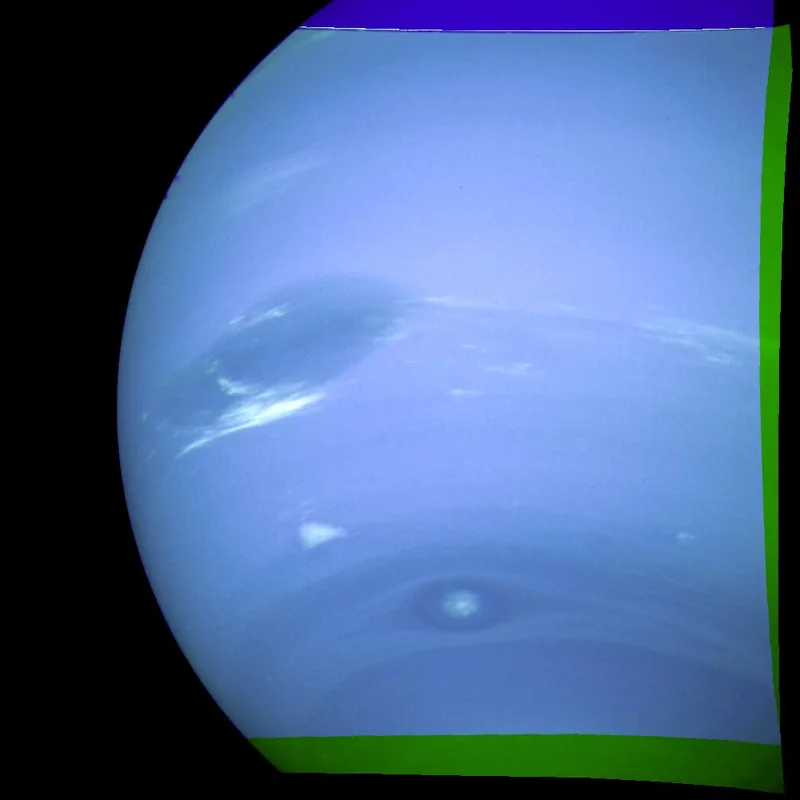
The close still above is the last face-on Voyager view of that storm, shuttered 45 hours before closest approach. Beside it, PIA00049 names three features Voyager had been watching: the Great Dark Spot, the bright Scooter, and Dark Spot 2.
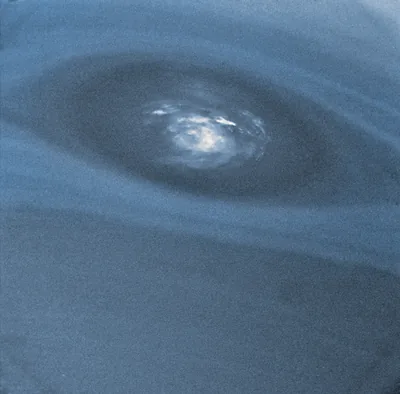
PIA00049: reconstructed from two Voyager 2 narrow-angle images, through the green and clear filters. At the north (top) is the Great Dark Spot, with bright white clouds that the caption says undergo rapid changes in appearance. To the south is the bright feature Voyager scientists nicknamed Scooter; still farther south is Dark Spot 2. Public domain.Photo: NASA / JPL · Public domain · NASA/JPL / Wikimedia CommonsThe official file caption is brief and clear: an enhanced colored image of Neptune’s Small Dark Spot (or Wizard’s Eye), NASA / JPL, 25 August 1989. Enhanced colour, not a claim about how the storm would look to the unaided eye. Public domain.Photo: NASA / JPL · Public domain · NASA/JPL / Wikimedia Commons
The Small Dark Spot, in the enhanced-colour frame above, is also nicknamed the Wizard’s Eye in the file caption. Enhanced colour, as labelled.
Two official ideas of “true colour”
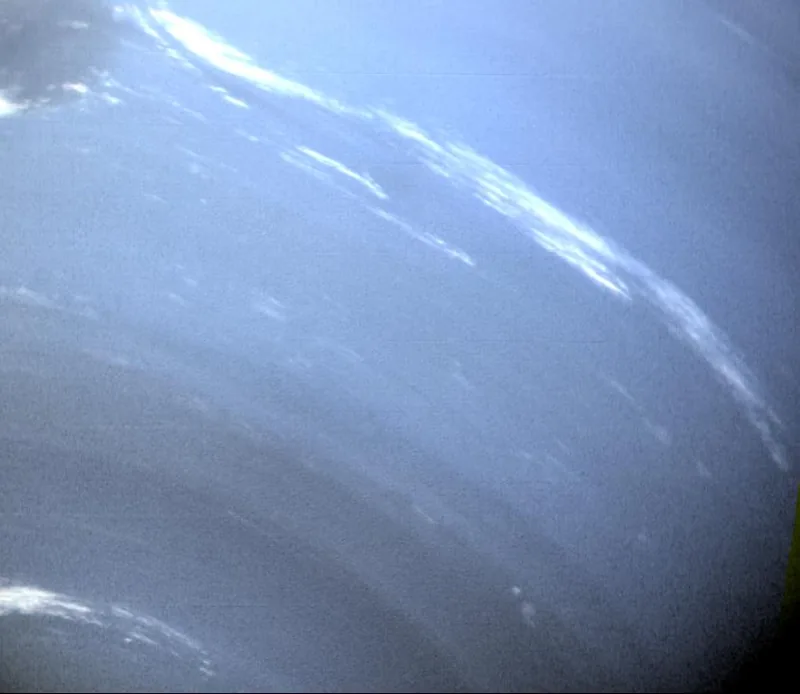
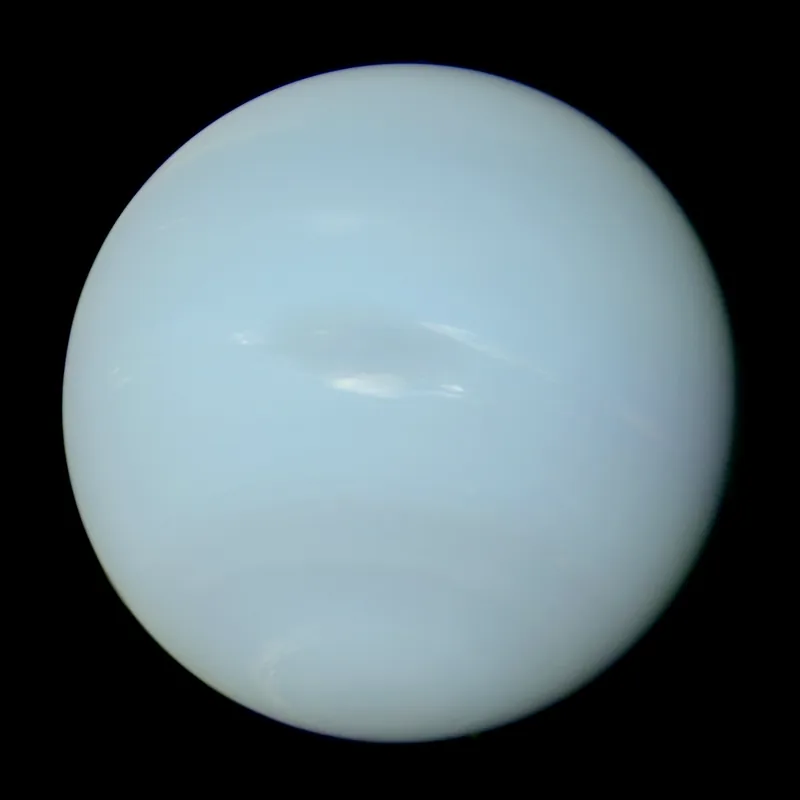
NASA Science says Neptune’s atmosphere is mostly hydrogen and helium with a little methane, and that methane absorbs other colours but reflects blue, giving the ice giants their similar hue. Many Voyager images, the same page says, show a much deeper blue because the team tweaked them to reveal clouds, compared with the hazy, uniform view of Uranus that Voyager 2 had captured in 1986. Researchers in 2024 re-processed the images, “showing the planets look much more alike than many thought.” [source]
PIA00063, taken by Voyager 2’s wide-angle camera from 590,000 kilometres (370,000 miles). The official caption says the image “has been processed to obtain true color balance,” with further processing to suppress the surface brightness of the white clouds so both polar structure and bright clouds east of the Great Dark Spot can be seen. That 1989 “true color” wording is kept beside the later colour-calibrated composite. Public domain.Photo: NASA / JPL · Public domain · NASA/JPL / Wikimedia CommonsA colour composite of Voyager 2 orange, green and blue frames from 17 August 1989, published on Commons as CC0 and “calibrated to best represent Neptune’s true color and appearance,” based on Irwin, Patrick G. J., et al. (23 December 2023). This is a later colour-calibrated reprocess, not a raw NASA still. NASA Science, separately, says researchers in 2024 re-processed Voyager images, “showing the planets look much more alike than many thought.”Photo: NASA / Voyager 2 / PDS / OPUS / Ardenau4, based on Irwin et al. · CC0 · CC0 composite based on Irwin et al. / Wikimedia Commons
The 1989 catalog still above, PIA00063, carries its own official wording: it “has been processed to obtain true color balance.” The paler portrait under it is a later colour-calibrated composite, based on Irwin et al. (23 December 2023) and published as CC0. This site does not pick a winner. It puts the labels where you can see them.
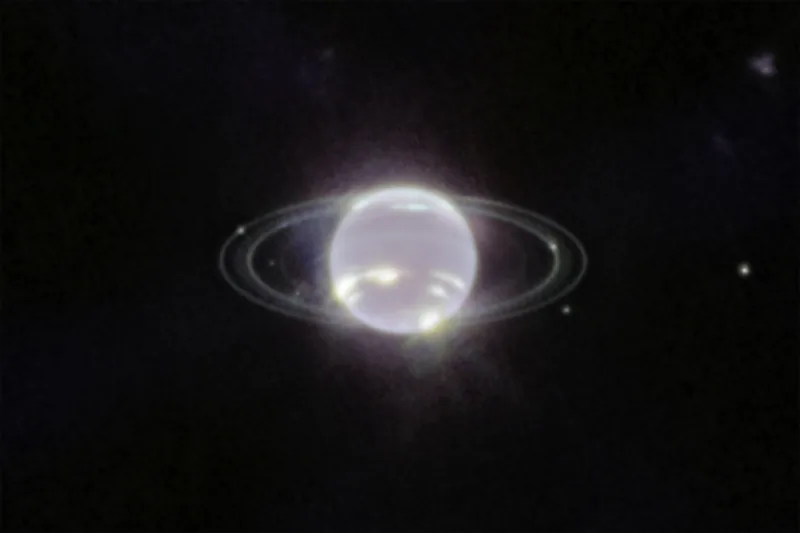
Webb’s Near-Infrared Camera (NIRCam) image of Neptune, taken on 12 July 2022. The official caption says it brings the planet’s rings into full focus for the first time in more than three decades. Bright patches in the southern hemisphere are described as high-altitude methane-ice clouds; a thin line of brightness circling the equator “could be a visual signature of global atmospheric circulation.” Infrared, not a visible-light postcard. Public domain.Photo: NASA, ESA, CSA, STScI; image processing by Joseph DePasquale (STScI) · Public domain · NASA/ESA/CSA/STScI / Wikimedia Commons
Webb, looking in near-infrared on 12 July 2022, found a different kind of weather to photograph: high-altitude methane-ice clouds, rings in focus for the first time in more than three decades, and a thin equatorial brightness the official caption treats carefully — it “could be” a signature of global circulation.
Keep the lights on
Enjoyed a planet found with a pencil, and the solar system’s windiest world?
No pop-ups. No intrusive advertising. Just interesting stuff. A little support helps the next planets.im site get built.