neptune.planets.im
The first planet found with mathematics is also the solar system’s windiest world.
NASA Science is clear: Neptune is the eighth and most distant planet, not visible to the unaided eye, and was the first world located by prediction. The official fact sheet, and that same facts page, then disagree in the useful way — rounded wording beside tabulated figures, not instead of them.
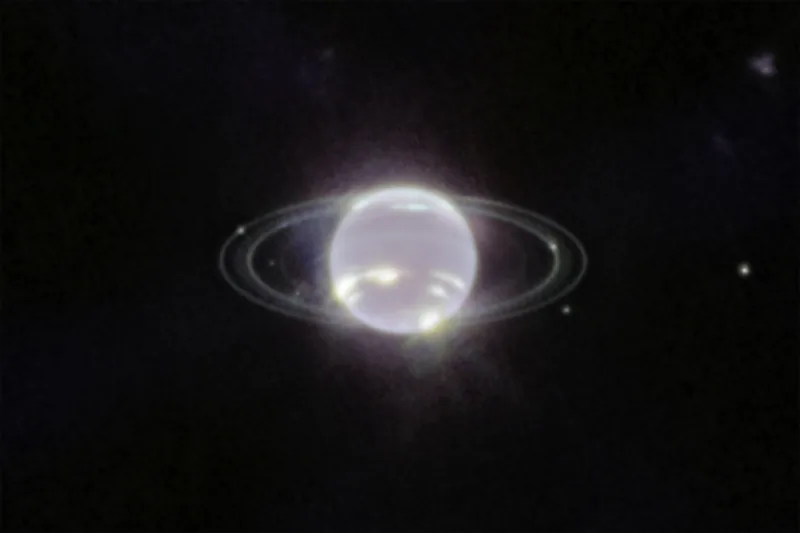
The last planet, found on a blackboard
NASA Science calls Neptune the eighth and most distant planet in our solar system, and the only planet not visible to the naked eye — Uranus, it says, is just barely visible for those with excellent eyesight under dark-sky conditions, provided you know where to look. [source] In 1846 it became the first planet located through mathematical predictions rather than through regular observations of the sky. Johann Gottfried Galle, at the Berlin Observatory, found it on his first night of searching, after Urbain Joseph Le Verrier sent him a predicted position. [source] The official fact sheet lists the discoverer as Johann Gottfried Galle, based on predictions by John Couch Adams and Urbain Leverrier, and the date as 23 September 1846. [source]
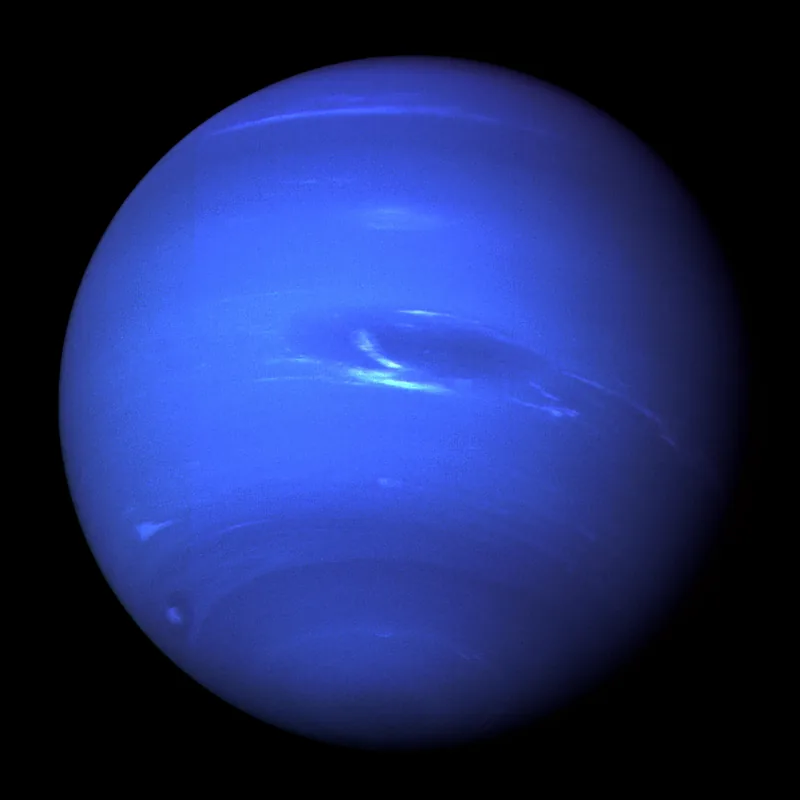
The portrait above is famous, and it is labelled. The file itself calls it an enhanced-color picture from Voyager 2, taken 4.4 million miles from the planet, 4 days and 20 hours before closest approach in August 1989. NASA Science is equally candid: many Voyager images “show Neptune as a much deeper blue” because “the Voyager team tweaked the images, to better reveal clouds and other distinctive features.” Researchers in 2024, the same official facts page says, re-processed the images, “showing the planets look much more alike than many thought.” [source] A later colour-calibrated composite sits on the weather desk, beside that official wording, not instead of it.
This is also, on NASA Science’s telling, our solar system’s windiest world. Those winds “whip clouds of frozen methane across the planet at speeds of more than 1,200 miles per hour (2,000 kilometres per hour).” [source] The fact sheet’s tabulated wind speeds are 0–580 m/s. [source] Both stay in view on the winds desk.
The windiest world
More than 1,200 mph on NASA Science; 0–580 m/s on the fact sheet. A year of 60,189.018 days, or about 165 Earth years.
Found with mathematics
Le Verrier, Adams, Galle, and a planet Galileo had already recorded as a fixed star in 1612 and 1613.
A dark spot, and two official blues
The Great Dark Spot large enough to contain the Earth, then gone; a 1989 “true color” caption beside a 2024 reprocess.
A backward moon, and stubborn ring arcs
Triton on a retrograde orbit, geysers more than 5 miles high, and four named arcs in the Adams ring.
Enjoyed a planet found with a pencil, and the solar system’s windiest world?
No pop-ups. No intrusive advertising. Just interesting stuff. A little support helps the next planets.im site get built.